FIZZ: Wastewater treatment research
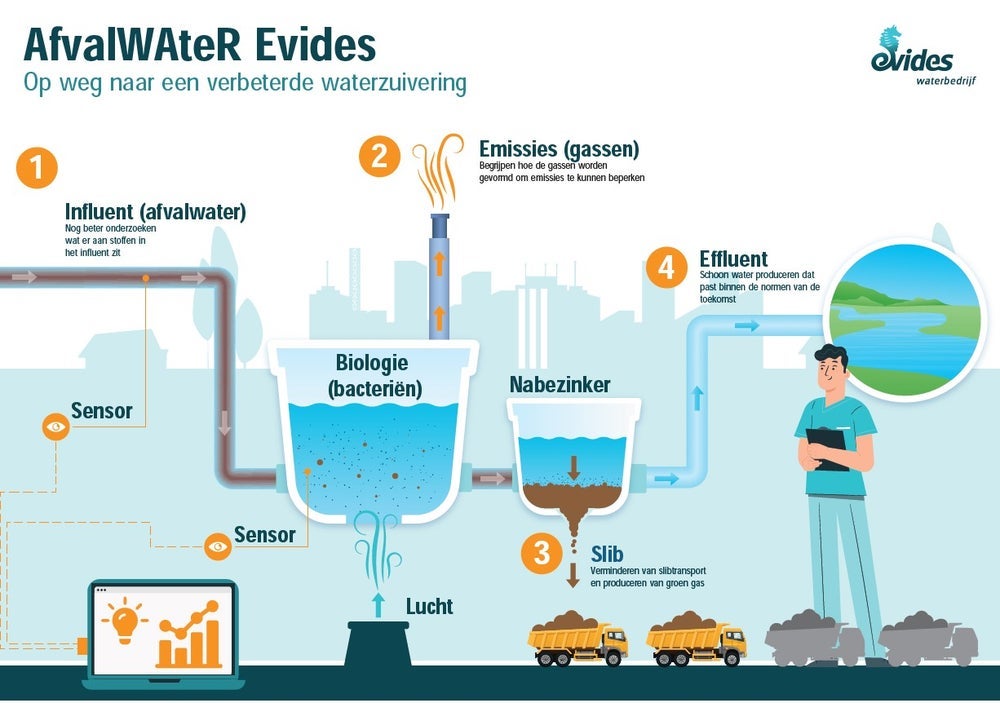
Within the FIZZ project (originally AWARE: AfvalWAteR Evides), improvements are being sought for existing and new wastewater treatment plants of Evides Industriewater, in order to produce cleaner effluents with a low environmental impact.
For the continuity of business processes, it is of great importance that polluted water from industry is efficiently purified before being discharged. By using innovative techniques, this can be done in an increasingly sustainable manner.
The challenge
What was the challenge?
The FIZZ project conducts research into the wastewater treatment of the future. Increasingly stringent requirements are being placed on the quality of treated wastewater (effluent). In addition, wastewater treatment impacts the environment through the emission of gases, energy and chemical consumption, and the processing of sewage sludge. To continue treating wastewater and processing sludge efficiently and with minimal environmental impact for current and new customers in the future, innovative techniques are required.
The research
What does this research look like?
To produce cleaner effluents in a wastewater treatment plant with less environmental impact, various innovative techniques are being investigated. Examples include effluent post-treatment and the use of sensors.
The FIZZ research is divided into 4 themes:
- Influent in control – more control over the quality and variation of incoming wastewater
- Cleaner effluents – inventory and reduction of various substances from effluent, such as plastics and substances of very high concern, and the use of AI software for improved effluent quality
- Sludge treatment – development of a sludge strategy and various sludge treatment methods (including improvement of sludge digestion)
- Emissions/circularity – inventory and reduction of emissions from the EIW wastewater treatment plants
The results
What result did this yield?
Over the past few years, many positive results have been achieved within the various studies. Below is an overview of the state of affairs in 2025.
Under the Influent in Control initiative, a TOC analyzer and UV-VIS sensors were tested on various influent streams at the Sloe Wastewater Treatment Plant to gain better control over substance concentrations in our influent, with the aim of using this to manage our processes. The TOC analyzer has become an integrated part of the purification system. Furthermore, an innovation discovery trajectory has been established for the biological treatment of nitrogen-rich streams. This involves conducting market research and exploring new techniques to process future streams.
Within cleaner effluents, new software (AI-based) was tested to control aeration at the Schiphol Wastewater Treatment Plant. The research revealed which hardware and software adjustments were necessary for purification, but also showed that the added value of the AI software itself was not high. New PA software already met the requirements sufficiently. In addition, research was conducted into the presence and removal of substances of very high concern and plastics. Measurements were performed for a number of these substances, after which removal methods were examined to reduce or even completely prevent their presence in the effluent.
For sludge processing, various techniques to improve sludge hydrolysis were examined, including the use of enzymes and thermal hydrolysis. None of these tests yielded satisfactory results, and the experiments were not scaled up further. A sludge strategy has also been developed. The current situation was mapped out, after which five strategic scenarios were elaborated to bring the sludge produced by the wastewater treatment plants to final processing. These include the optimization of the current separate streams and the central treatment of the sludge. The sludge strategy assists in future decision-making when adjustments and/or expansions are required.
Furthermore, research has been conducted into nitrous oxide and methane emissions within the theme of Emissions/Circularity. For nitrous oxide, measurements were performed and models developed for the Schiphol Wastewater Treatment Plant (AWZI) to gain insight into the volume of potential emissions and their causes. This revealed that, to prevent stressful situations for the microorganisms, the focus must be on carbon source dosing and oxygen concentrations. Measurements are currently being carried out at the Sloe Wastewater Treatment Plant (AWZI), as was done at the Schiphol Wastewater Treatment Plant, to determine which factors contribute to the formation of nitrous oxide and how these can be reduced. For methane, measurements were also performed at the Sloe and Schiphol Wastewater Treatment Plants, identifying hotspots for methane emissions. Subsequently, reduction measures were proposed, of which the capture of methane from anaerobic effluent and sludge storage at the Sloe Wastewater Treatment Plant, and the improvement of the sludge digester at the Schiphol Wastewater Treatment Plant, are being further developed as concepts.
Finally, a new lab has been built within Delft Blue Innovations, where experiments can be conducted in a controlled environment. This allows us to support our purification processes and test innovations on a lab scale.
For more information about the FIZZ research, please feel free to contact David Moed & Marthe de Graaff .